Background
Although authors are not unanimous about the primitive human occupation of this site, believing that it dates back to a prehistoric hill fort, archaeological research has brought to light evidence from the Roman period (coins from the 1st century BC) and the medieval period (medals). Some authors also identify examples of Roman-style construction in some sections at the base of the walls.
From the 3rd century onwards, the site was occupied by other groups, namely the Alans, the Visigoths and the Muslims, the latter from the 8th century onwards. In the 13th century, the fortification already existed, which they called Al-morolan (high stone).
The origin of its name cannot be determined, and it is also difficult to clarify its meaning and spelling, of which variations are known: Almoriol, Almorol, Almourel, Almuriel. Other authors establish a connection with the term Moron, which Strabo would have referred to as a city situated on the banks of the Tagus, or with the term Muriella, which appears in the description of the delimitation of the Bishopric of Egitânia and Corretânea.
The medieval castle

At the time of the Christian À época da Reconquest of the Iberian Peninsula, when this region was occupied by Portuguese forces, Almourol was conquered in 1129 by Afonso I of Portugal (1112-1185). The sovereign handed it over to the Knights of the Order of the Templars, who were then in charge of populating the territory between the Mondego and Tagus rivers, and defending the then capital of Portugal, Coimbra.
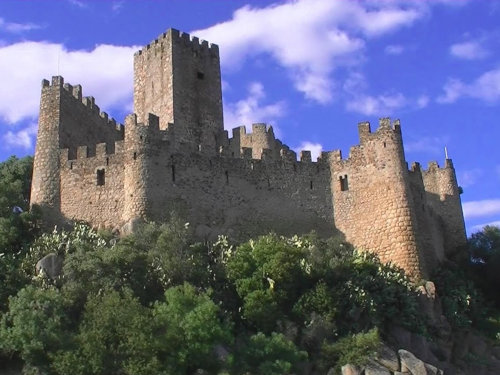
At this stage, the castle was rebuilt, having acquired, in general terms, its current features, characteristic of Templar architecture: quadrangular spaces, high walls, reinforced by attached towers. It had 9 towers and a taller one and in the window facing east there is a Templar cross. Dominated by a keep. An epigraphic plaque, placed above the main gate, states that the works were completed in 1171, two years after the completion of the Castle of Tomar, built by order of Gualdim Pais, son of Paio Ramires. The same architectural features are also present in the Castle of Idanha, Monsanto, Pombal, Tomar and Zêzere, its contemporaries.

Under the care of the Order, established as the headquarters of a Commandery, the castle became a key point in the Tagus region, controlling the trade of olive oil, wheat, pork, fruit and wood between the different regions of the territory and Lisbon. It is also believed that there was a settlement associated with the castle, on one or both banks of the river, since, in 1170, a charter was granted to its residents.
With the advance of the reconquest to the south and the extinction of the Order of the Templars in 1311 by Pope Clement V during the reign of Denis of Portugal (1279-1325), the structure passed to the Order of Christ, later losing importance, having undergone several alterations.
From the 18th century to the present day
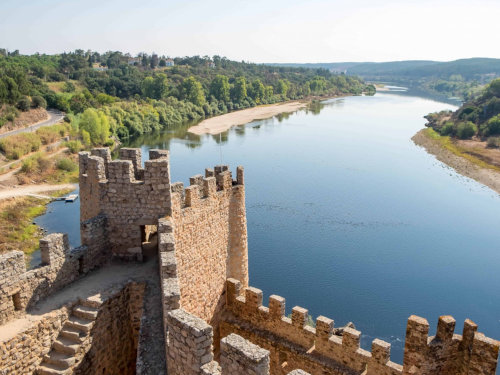
A victim of the 1755 earthquake, the structure was damaged and underwent further changes during the Romantic period of the 19th century. During this period, and in keeping with the then-current philosophy of valuing works of the past in light of an ideal poetic vision, the castle was subject to decorative alterations, including the uniform crowning of the walls with Battlements and Merlons.
The castle was handed over to the Portuguese Army in the second half of the 19th century, under the responsibility of the commander of the Tancos Practical School of Engineering, to which it has remained to this day.
In the 20th century it was classified as a National Monument of Portugal by Decree of 16 June 1910. During the Portuguese Estado Novo the complex was adapted as the Official Residence of the Portuguese Republic, where some important official events took place. To this end, new interventions were promoted in the 1940s and 1950s, reinforcing aspects of an ideology of nationality cultivated by the regime. season.
At the beginning of June 2006, two new docks for tourist boats were opened: one on the right bank of the River Tagus and another in the south of the island.
In September 2013, work began on improving the walls and working on the keep of Almourol Castle to create a museum space.
The works, which will last for six months and involve an investment of around 500 thousand euros, will focus on several areas of disintegration of the wall and towers, with their waterproofing, water drainage and improvement of the walls.
The intervention in the keep will focus on in replacing the current terrace, in installing a metal staircase for vertical circulation and in installing an exhibition system for content relating to the Templars, aiming to preserve and protect the monument and providing it with better accessibility and usability.
Currently it is It is possible to visit Almourol Castle and take trips on the Tagus River, adding value and interest to visits to the Monument. From Tancos, Arripiado and Vila Nova da Barquinha.
Features

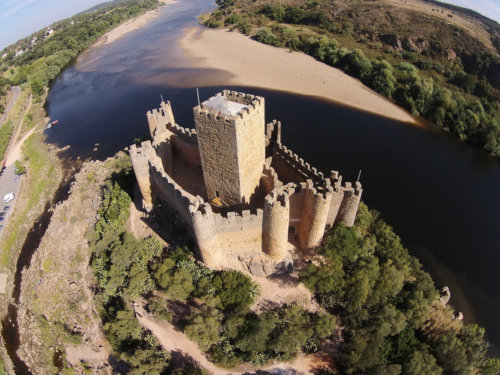
The building, made of granite stonework and mortared masonry, has an irregular (organic) plan, reflecting the unevenness of the terrain, and is divided into two levels, a lower exterior level and a higher interior level.
The first level is accessed through the main entrance, where there are tombstones that refer to the intervention of Gualdim Pais and where the name of the worker and the year in which the intervention took place are mentioned. In this space the walls have nine tall circular towers (four equidistant to the west and five to the east) and here you can also find the Treason Gate and traces of what must have been a well.
- Going up a few steps and going through another gate you enter the second level, the highest interior area where the quadrangular Keep stands, a characteristic element of the Templars, built in the 12th century. This three-story structure only has the footings as its original element (where the wooden beams would be supported) and a slapstick cross above the window, a symbol adopted by the Templars. Here the sections of walls crowned by Battlements and loopholes have steps that provide access to the top of the wall and the path that runs along it, the battlement. Communication between the different parts of the castle can be done through several stone passages.
Other paths were built around the islet, allowing not only the path that embraces the castle, but also the possibility of seeing the surrounding landscape from various perspectives.
The epigraphic question
On the main door of the castle, an epigraphic inscription dated from the era of 1209 (1171), mentions, in addition to the Braga native Gualdim Pais and his military action against the Muslims in Egypt and Syria, his rise to power leadership of the Order of the Temple in Portugal and subsequent construction of the castles of Pombal, Tomar, Zêzere, Cardiga and Almourol (…factus domus Templi Portugalis procurator, hoc construxit castrum Palumbare, Tomar, Ozezar, Cardig, et hoc ad Almourol), showing that, in that year, the castle of Almourol was, like the others indicated, already built. However, a second inscription, above the interior door, states that it was in 1209 that Gualdim Pais built the Castle of Almourol. A third inscription, over the door of the sacristy of the church of the Convent of Tomar, also dated from the era of 1209, similar to the first, except in the enumeration of castles, which also includes those of Idanha and Monsanto, which shows that this third one is later than the first, since these last two castles were built after 1171.
Legends
Houve várias histórias populares exacerbam o romantismo associado ao castelo templário, entre as quais:
- In the early days of the Reconquista, D.Ramiro, a Christian knight, was returning proudly from battles against the Muslims when he encountered two Moors, a mother and daughter. The young woman was carrying a jug of water, which, frightened, she dropped when the knight rudely asked her to drink. Enraged, he had just taken the lives of the two women when a young Moor, the victims' son and brother, appeared and was quickly taken prisoner. D.Ramiro took the captive to his castle, where he lived with his own wife and daughter, whom the Moorish prisoner soon planned to murder in retaliation. However, if The mother began to administer a slow-acting poison, and ended up falling in love with her daughter, whom the father planned to marry to a knight of his faith. Reciprocated by the young woman, who had learned of her father's plans in the meantime, the lovers left the castle and disappeared forever. Legend has it that, on the nights of Saint John, the couple can be seen embracing at the top of the keep and, at their feet, begging for forgiveness, the cruel D.Ramiro. (in: PINHO LEAL, Augusto Soares d'Azevedo Barbosa de. Ancient and modern Portugal: geographic, statistical, chorographical, heraldic, archaeological, historical, biographical and etymological dictionary of all the cities, towns and parishes of Portugal and of a large number of villages… (12 vols.). Lisbon: 1872 et seq.)
- An Arab lord from Almourol was betrayed by the Christian knight with whom his daughter fell in love, and to whom she revealed the secrets of entering the castle. The knight used the information to set up an ambush and the emir and his daughter preferred to throw themselves from the walls into the river rather than remain in captivity.
- The heroic knight Palmeirim was struck by a great storm that forced the ship he was travelling on, from England to Constantinople, to land on the Portuguese coast, anchoring in the Douro River. Disembarking in the city of Porto, the knight learned of the adventures of some knights who had fought with the giant Almourol, who in his castle in the middle of the River Tagus guarded the beautiful princess Misaguarda and her ladies. In search of adventure, Palmeirim moves south, where, bank of the Tagus overlooks the Almourol Castle in the distance. Coming closer, you see the end of the fight between two knights in a square next to the castle, recognizing the winner as the Sad Knight, with whom he had already fought. dueled. As a sign of victory, the Sad Knight joins his shield with those of others, who have also already joined. had obtained it. This shield depicted his lady, the beautiful princess Misaguarda, with whom Palmeirim fell in love. The fight between Palmeirim and Cavaleiro Triste falls, night falls, ending the fight without a winner. The Sad Knight is taken to the castle to treat his wounds, while Palmeirim goes to seek help in a nearby village. Neither one nor the other, however, achieves the favor of the princess, who advises the former to withdraw and give up new combats for a year, while Palmeirim resumes his path to Constantinople. After this feat, the giant Almourol was attacked and defeated by another giant, Dramusiando, under whose protection the beautiful princess and her court are now.
Events of the time
1161 - Éacute;vora, Beja and Alcácer do Sal fall into the hands of the
Moors.
1162 - Afonso I of Portugal reconquers Beja, which
had fallen into
the
hands of the Moors.
1163 - Occupation of Salamanca by Afonso I of
Portugal.
1163 - Occupation of Salamanca by Afonso I of Portugal.
1165 - À época da Reconquest of Éacute;vora.
1166 - Taking of Serpa and Moura by Afonso I of
Portugal.
1168 - Entry of Geraldo Sem
Pavor in Badajoz.
1169 - Afonso I of Portugal grants the Templars a
third of what
they conquered in Alentejo.
- Geraldo Sem Pavor takes over Badajoz.
- Afonso I of Portugal accidentally injured in Badajoz and
imprisoned.
- Afonso I of Portugal removes Pêro Pais da Maia from the
position of ensign-general.
1170 -August 15 - In Coimbra Sancho, future
king of
Portugal,
is knighted by his father Afonso
Henriques.
1172 - Establishment of the Order of Santiago
in Portugal,
being granted Arruda dos Vinhos and, later, Alcácer do Sal, Almada and Palmela.
- Afonso I of Portugal associates
his son D. Sancho with the government of the Kingdom.
1174 -Prince Dom Sancho of Portugal, future King Sancho I of Portugal,
marries Dulce Berenguer, Infanta of Aragon.
1178 -Important expedition of the Infante D. Sancho into Muslim
territory,
which reached and destroyed the outskirts of Seville,
on the right bank of the river Guadalquivir.
1179 - The Pope recognizes Portugal as a kingdom.
- May 23 - Bull "Manifestis
Probatum",
by Alexandre III,
confirming the
possession of
the Kingdom of
Portugal
to D. Afonso Henriques and his successors.
- D.
Afonso Henriques and his son Sancho, future Sancho I of Portugal, grant charters to
Santarém, Coimbra and Lisbon.
1180 - Almohad invasion of Portugal by
the
Caliph Abu Ya'qub
Yusuf.
- Defeat of Prince D. Sancho in the Battle of Arganal, near Ciudad Rodrigo,
before
the army of the kingdom of León.
July 29 - Date indicated as the first naval battle between a Portuguese
armada, commanded by D.
Fuas Roupinho, and an Arab
force, led by Ben
Jami, off Cape Espichel.
1183 - Creation of the Inquisition through
the Council of
Verona.
1185 - Sancho I succeeds Afonso I of Portugal as king of Portugal.
- Construction of the Cathedral of
Évora.
1187 - October 2 - Saladin conquers Jerusalem from the
Crusaders; in response, Pope Gregory
VIII proposes launching the Third
Crusade.
- Sancho
I grants a charter
to Viseu, Avô,
Folgosinho, Bragança and Penarroias.
1189 - Sancho I begins to call himself King of Portugal and the
Algarves.
1190 - The Third Crusade, commanded by Richard the
Lionheart and Philip Augustus,
blessed by
Pope Gregory VIII,
sets out with
the mission of reconquering Jerusalem.
- Foundation of the first Louvre Castle.
1191 - July 12 - Third Crusade: Crusaders conquer Acre, in
Palestine.
- August 22 - Third Crusade: King Richard the Lionheart orders
the killing of 2,700 Muslim prisoners.
1194 - Inti Yupanqui founds the Inca Empire (Peru).
1196 - Sancho I
concludes a treaty of alliance with Alfonso
VIII of Castile, Alfonso II of
Aragon and the King of Navarre. A war breaks out between the kingdoms of Portugal and León, and
the Pope grants the Portuguese monarch and his armies the same indulgences granted by the Holy
See. to those who fought the infidels.
1198 - Border battles against the Leonese, in the regions of Beira
Alta and Trás-os-Montes, where some members of the most important families of the
Portuguese nobility lost their lives.
1199 - D.
Sancho I writes the charter that gives origin to Guarda, Portuguese city, on November
27th.